
59 BitPhase
Resonant 4-stage phaser with wide modulation sweeps, tremolo blending, and Burst-mode degradation
Panel
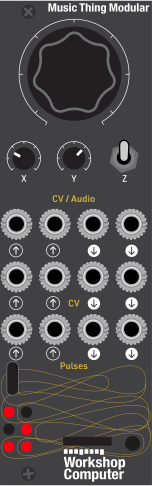 RateSweep DepthResonanceMain Audio
InSecondary
Audio InRate CVResonance CVLFO ResetProcessed
Out AProcessed
Out BPhaser LFO
CVTremolo LFO
CVBurst ActivePhaser LFO
Phase
Controls
Rate
Speed of the internal phaser and tremolo LFOs
Sweep Depth
Phaser modulation depth from narrow movement to wide sweeping notches
Resonance
Phaser feedback amount from smooth phasing to edge-of-self-oscillation
Inputs
Outputs
Main Audio In
Main audio input for the phaser engine
Secondary Audio In
Secondary audio input if used by firmware or patch
Rate CV
Modulates phaser and tremolo speed
Resonance CV
Modulates phaser feedback amount
LFO Reset
Resets phaser LFO so sweep can be clock-synchronised
Processed Out A
Dual mono output of processed signal
Processed Out B
Dual mono output of processed signal
Phaser LFO CV
Phaser LFO waveform output
Tremolo LFO CV
Tremolo LFO waveform output
Burst Active
High while Burst mode is active
Phaser LFO Phase
Phaser LFO phase indicator for synchronising external events
LEDs
LED 1 follows the rate position.
LED 2 follows the phaser LFO position.
LED 3 follows sweep position.
LED 4 follows Burst intensity.
LED 5 indicates Burst mode status.
LED 6 monitors Pulse In 1.
README
BitPhase
BitPhase is a resonant 4-stage phaser for the Music Thing Modular Workshop Computer.
Inspired by the behaviour of classic feedback phasers such as the EarthQuaker Devices Grand Orbiter, BitPhase combines deep notch filtering, wide modulation sweeps, controllable resonance, tremolo blending, and a digital Burst mode for degraded and unstable textures.
At low settings it provides subtle movement and phase animation. At higher resonance settings it produces pronounced notch emphasis and can approach self-oscillation for synth-like tones and feedback sweeps.
Features
- 4-stage all-pass phaser engine
- Variable resonance and feedback
- Edge-of-self-oscillation behaviour
- Independent phaser and tremolo LFOs
- Pulse-syncable phaser sweep
- Three operating modes
- Burst-mode digital degradation
- CV control of rate and resonance
- Dual CV outputs
- Dual pulse outputs
Controls
Main Knob — Rate
Controls the speed of both internal LFOs.
Phaser LFO
- Approx. 0.05 Hz – 6 Hz
- Exponential response for slower low-speed sweeps
Tremolo LFO
- Approx. 0.5 Hz – 20 Hz
- Tracks the Rate control independently of the phaser sweep
X Knob — Sweep Depth
Controls phaser modulation depth.
Low settings:
- Narrow notch movement
- Subtle phase animation
High settings:
- Wide frequency sweeps
- Deep moving notches
- More dramatic modulation
Y Knob — Resonance
Controls phaser feedback amount.
Low settings:
- Smooth phasing
- Gentle notch emphasis
Mid settings:
- Stronger resonance
- More pronounced phaser character
High settings:
- Aggressive feedback
- Sharper notches
- Edge-of-self-oscillation behaviour
At maximum settings the phaser can approach self-generated tones depending on sweep position and input material.
CV Inputs
CV In 1 — Rate CV
Modulates phaser and tremolo speed.
Useful for:
- Clock-derived sweeps
- Envelope-controlled rate changes
- Random modulation
CV In 2 — Resonance CV
Modulates phaser feedback amount.
Useful for:
- Dynamic resonance changes
- Envelope-controlled emphasis
- Oscillation bursts
- Performance modulation
Modes
▲ Up — Phaser
Pure resonant phaser.
Features:
- 4-stage all-pass network
- Resonant feedback path
- Wide sweep capability
- Cleanest signal path
Ideal for:
- Traditional phasing
- Resonant sweeps
- Feedback textures
● Middle — Mix
Blends phasing with tremolo.
Features:
- Phaser output
- Tremolo-modulated phaser layer
- Equal blend of both signals
Produces:
- Animated stereo-style movement
- Pulsing modulation
- More rhythmic textures
▼ Down — Burst
Digital degradation mode.
Adds:
- Sample-and-hold reduction
- Bit-depth reduction
- Random repeat corruption
- Increased instability
Burst mode operates on the resonant phaser signal and can create highly animated lo-fi textures while retaining the core phaser character.
Burst Degradation System
Burst mode introduces controlled digital corruption.
Sample & Hold
Temporarily freezes sample updates.
Bit Reduction
Applies progressive bit masking.
Repeat Corruption
Randomly repeats previous samples.
Presence Compensation
Additional dry reinforcement prevents complete collapse of the signal during extreme degradation.
Synchronisation
Pulse Input
Resets the phaser LFO.
Each rising edge:
- Resets phaser sweep position
- Synchronises modulation cycles
- Enables clock-locked phase movement
The tremolo LFO continues independently.
Outputs
Audio Out 1 / Audio Out 2
Dual mono output of the processed signal.
CV Out 1
Phaser LFO waveform.
CV Out 2
Tremolo LFO waveform.
Pulse Out 1
High while Burst mode is active.
Pulse Out 2
Phaser LFO phase indicator.
Useful for synchronising external modulation events.
LEDs
- LED 1 — Rate position
- LED 2 — Phaser LFO position
- LED 3 — Sweep position
- LED 4 — Burst intensity indicator
- LED 5 — Burst mode status
- LED 6 — Pulse input monitor