
433 433 Sense of Space
433 Sense of Space is supplied as 2 MB and 16 MB builds. The 2 MB build uses a compact 10 kHz stereo 8-bit ambience asset, while the 16 MB build uses a cleaner 24 kHz stereo 16-bit ambience asset. Switch Up stops and arms the performance, Switch Middle starts three 91 second loops sourced from 1:30-3:01 of the BBC recording, and the left column LEDs count down from three loops to zero. Switch Down or Pulse In 1 triggers a short chair/stool creak one-shot representing the musician shifting in their seat. Pulse In 2 restarts the full performance from the beginning.
Panel
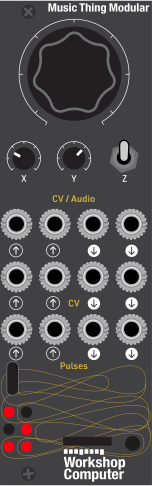 StartSpaceAmountLeftRight
Controls
Start
Start a three-loop 4'33" performance from the beginning
Space
Reverb character, from small room to a restrained cathedral-like hall
Amount
Dry/wet reverb amount
Z up: MAIN: Stop / Arm.
Z middle: MAIN: Start.
MAIN: Seat Creak
Outputs
Left
Left stereo output
Right
Right stereo output
LEDs
Loop 1 remaining
Running indicator
Loop 2 remaining
Running indicator
Loop 3 remaining
Running indicator
README
433 Sense of Space
A whimsical loop card for the Music Thing Workshop Computer, inspired by John Cage's 4'33": a small fragment of theatre ambience is looped for about 91 seconds and placed in imaginary performance spaces.
It is not silence. It is the room, the audience, the building, and the slightly ridiculous act of listening very hard.
Controls
| Control | Function |
|---|---|
| Main | Performer restlessness: automatic fidgets from none to occasional |
| X | Performance space, from small dry room to a restrained cathedral-like hall |
| Y | Reverb amount, from almost dry to fully washed |
| Switch Up | Stop and arm the performance |
| Switch Middle | Start from the beginning and play three loops |
| Switch Down | Trigger musician-shifts-in-seat one-shot |
| Pulse In 1 | Trigger musician-shifts-in-seat one-shot on rising edge |
| Pulse In 2 | Restart the three-loop performance from the beginning |
The card powers up armed rather than playing. Move the switch Up to stop, reset the audio position, clear the reverb tail, and relight the three countdown LEDs. Move the switch to Middle to begin a complete 4'33" performance: three passes through the 91 second ambience loop, then automatic stop and mute. Moving the switch Down during a performance, or sending a rising edge to Pulse In 1, triggers the chair/stool creak one-shot; returning to Middle does not restart the performance while it is already running. Sending a rising edge to Pulse In 2 restarts the three-loop performance immediately, as if the card had been stopped/armed and then started again.
The creak is intentionally quiet and sits behind the room ambience, as if the performer has shifted slightly rather than knocked over the furniture.
Main adds a little unattended human presence. Fully anticlockwise keeps the card manual-only: creaks happen only from Switch Down or Pulse In 1. Turning Main up allows occasional automatic creaks during the three-loop performance, with shorter random waits as the knob is turned clockwise.
Automatic restlessness waits for about 20 seconds after the performance starts before the first possible fidget. At maximum restlessness, automatic creaks are spaced by roughly 5-15 seconds; lower settings stretch the random waits toward about 90 seconds. Automatic creaks play at 25% gain, while manual/Pulse-triggered creaks play at 37.5% gain, so the unattended fidgets still sit slightly farther back in the room.
Outputs
| Jack | Function |
|---|---|
| Audio Out 1 | Left stereo output |
| Audio Out 2 | Right stereo output |
LEDs
The left column is a simple 4'33" countdown. Three LEDs are lit before playing and at the start of the performance. One LED goes out after each 91 second loop. After the third loop, the card stops and the audio mutes.
The right column glows dimly while the performance is running.
Builds
This stable version has both 2 MB and 16 MB builds:
| File | Card size | Audio asset |
|---|---|---|
UF2/433_sense_of_space_2mb.uf2 |
2 MB | 91 seconds, 10 kHz stereo signed 8-bit, sourced from 1:30-3:01 |
UF2/433_sense_of_space_16mb.uf2 |
16 MB | 91 seconds, 24 kHz stereo signed 16-bit, sourced from 1:30-3:01 |
The two builds use the same code, controls, LED countdown, reverb, restlessness automation, loop length, 2 second loop crossfade, and chair creak one-shot. The only intentional difference is the ambience sample format:
| Version | Difference |
|---|---|
| 2 MB | Uses a 10 kHz stereo ambience asset so the complete firmware fits on a 2 MB card. Current binary payload is about 1.88 MB, leaving roughly 218 KB spare. |
| 16 MB | Uses a 24 kHz stereo 16-bit ambience asset for much lower sample grain and cleaner room detail. Current binary payload is about 8.80 MB, leaving about 7.98 MB spare. |
The UF2 files are larger than their flash payloads because UF2 adds block metadata. The flash payload inside each UF2 is the relevant storage size.
The 16 MB UF2 can take much longer to copy/flash than the 2 MB UF2. This is normal: the higher-quality 16-bit ambience makes the UF2 wrapper substantially larger even though the actual flash payload still fits comfortably on a 16 MB card.
CC0 Mayakovsky Version
A separate copyright-clean version is included in mayakovsky_cc0/. It uses a
Creative Commons 0 Mayakovsky Theatre audience recording from approximately
4:45-6:16, avoiding speech heard around 6:25, while keeping the same controls,
LED countdown, pulse inputs, restlessness behaviour, reverb, and chair creak.
The main BBC-derived version remains the preferred sound for the card: its audience perspective is more intimate, as if heard from the stage during a performance. The Mayakovsky CC0 version is more spacious and public-sounding, but has simpler reuse terms because all embedded ambience and chair creak audio is CC0.
Mayakovsky CC0 UF2s:
| File | Card size | Audio asset |
|---|---|---|
mayakovsky_cc0/UF2/433_sense_of_space_2mb_mayakovsky_cc0.uf2 |
2 MB | 91 seconds, 10 kHz stereo signed 8-bit, sourced from 4:45-6:16 |
mayakovsky_cc0/UF2/433_sense_of_space_16mb_mayakovsky_cc0.uf2 |
16 MB | 91 seconds, 24 kHz stereo signed 16-bit, sourced from 4:45-6:16 |
Pulse Input
Pulse In 1 triggers the chair/stool creak on a rising edge. It retriggers the same one-shot used by Switch Down, with no extra audio data. Pulse-triggered creaks use the same level as Switch Down creaks, so they are more deliberate than the quieter automatic restlessness fidgets.
Pulse In 2 restarts the full 4'33" performance from the beginning. It resets the loop position, relights the three countdown LEDs, clears the reverb tail, starts playback immediately, and restarts the 20 second restlessness grace period.
Seat Creak Candidate
Selected candidate: https://freesound.org/people/unkleceeg/sounds/276473/
Chair creaking back and forth 01.wav by unkleceeg, licensed Creative Commons 0.
The one-shot currently baked into the firmware is a 1.35 second stereo signed 8-bit
12 kHz excerpt from around 7.95 seconds in the original WAV. It is mixed into the dry
loop before the reverb, so it appears inside the selected performance space.
Licence And Source Audio
See LICENSE for the mixed-license terms covering this folder.
The embedded ambience is derived from BBC Sound Effects Archive item 07003043
(bbc_theatres--_07003043). BBC Sound Effects licensing allows archive sounds to be
used "for non-commercial, personal or research purposes", or licensed separately for
other uses:
https://sound-effects.bbcrewind.co.uk/licensing
Because the UF2 files include that BBC-derived audio, the complete firmware images are not offered as a general Creative Commons release. Any public, commercial, or otherwise non-personal use should be checked against the BBC terms or covered by a separate BBC licence.
Technical Notes
The source is baked into the firmware as a 91 second stereo signed 8-bit loop taken
from 1:30-3:01 of BBC Sound Effects Archive item 07003043. Playback is linearly
interpolated to the Workshop Computer's 48 kHz audio rate, then sent through the
integer Dattorro-style reverb from Reverb+. The X control deliberately avoids the
near-freeze end of the reverb algorithm so the largest setting remains musical
rather than turning the quiet ambience into noise.