
26 Clockwork
6-channel polyrhythmic clock, gate, and LFO/envelope generator inspired by Pamela's Workout.
Panel
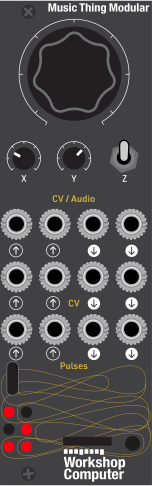 Modifier /
ShapeSteps /
LevelContext-dependentModifier Mod
(Audio 1)Fills Mod
(Audio 2)Wave Param
ModProbability
ModClock SyncReset InOut 1 (Audio
Out 1)Out 2 (Audio
Out 2)Out 3 (CV
Out 1)Out 4 (CV
Out 2)Out 5 (Pulse
Out 1)Out 6 (Pulse
Out 2)
Controls
Modifier / Shape
Master modifier or waveform shape select depending on switch tier
Steps / Level
Euclidean steps or output level/delay depending on switch tier
Context-dependent
Euclidean Fills (Steps > 0) or LFO Phase Offset (Steps = 0) depending on switch tier
Inputs
Outputs
Modifier Mod (Audio 1)
CV control over active channel modifier (speed division/multiplication) or external Schmitt triggers
Fills Mod (Audio 2)
CV control over active channel Euclidean fills or external S&H sampling source
Wave Param Mod
CV control over the active channel's wave parameter, or external Delay/Math carrier input
Probability Mod
CV control over the active channel's trigger probability
Clock Sync
External clock source sync input
Reset In
Clock reset trigger or run gate
Out 1 (Audio Out 1)
Channel 1 CV/Gate output (SPI DAC)
Out 2 (Audio Out 2)
Channel 2 CV/Gate output (SPI DAC)
Out 3 (CV Out 1)
Channel 3 CV/Gate output (PWM)
Out 4 (CV Out 2)
Channel 4 CV/Gate output (PWM)
Out 5 (Pulse Out 1)
Channel 5 Digital Gate output (GPIO)
Out 6 (Pulse Out 2)
Channel 6 Digital Gate output (GPIO)
LEDs
Page display: active channel is lit (LED 0-5). On the GLOBAL page, all 6 LEDs pulse gently.
LED layout on module: Top row (LED 0, 1 = bits 0-1); Middle row (LED 2, 3 = bits 2-3); Bottom row (LED 4, 5 = bits 4-5).
Analog shapes 3x2 matrix maps (Top/Mid/Bot): Gate [○○/○○/○○], Ratchet [●○/○○/○○], Sine [○●/○○/○○], Triangle [●●/○○/○○], Saw ↑ [○○/●○/○○], Saw ↓ [●○/●○/○○], Trapezoid [○●/●○/○○], Hump [●●/●○/○○], Envelope [○○/○●/○○], Log Env [●○/○●/○○], S&H [○●/○●/○○], Smooth [●●/○●/○○], Delay [○○/●●/○○], Math [●○/●●/○○].
Digital shapes 3x2 matrix maps (Top/Mid/Bot): Gate [○○/○○/○○], Ratchet [●○/○○/○○], Trigger [○●/○○/○○], Burst [●●/○○/○○], Random [○○/●○/○○], Utility [●○/●○/○○].
README
Clockwork is a 6-channel polyrhythmic timing and modulation generator inspired by Pamela's Workout. It turns the Workshop Computer into a central clock, gate sequencer, and LFO generator.
How to control it
- Toggle UP (Sound Shape): MAIN = Waveform, X = Level/Delay, Y = Wave Parameter. A quick flick UP (<400ms) toggles Play/Pause.
- Toggle MIDDLE (Rhythm): MAIN = Modifier (/2048 to x128, with x1 at noon), X = Euclidean Steps (0-16), Y = Fills (steps > 0) or Phase Offset (steps = 0).
- Toggle DOWN (Momentary): Tap to cycle pages (Outputs 1-6 & Global). Hold to edit Advanced Settings (MAIN = Loop length, X = Probability, Y = Step Offset [steps > 0] or Quantizer Scale [steps = 0]).
External CV Inputs (Jacks 1-4)
When plugged, overriding behavior occurs:
- CV Modulation (Default): CV modulates the Wave Parameter (Knob Y in UP mode).
- External S&H / Smooth: Channels sample the input voltage instead of internal random noise.
- Delay Input: Delay shape records and delays the input jack voltage.
- Math Carrier: Math shape carrier signal switches to the input jack voltage.
- External Triggers: Channels set to cross-channel triggers clock their loops from external gate edges.
Special Speed Settings (Right of Wheel)
- Cross-Channel Triggers: Clocks loop from another channel (or physical jack if connected).
- MIDI Mode: Clocks loop from USB MIDI. Maps Outputs: S&H = 1V/Oct CV, Smooth = Velocity CV, Envelopes = Velocity-scaled decays, Gate = Gate.
LED Wave Shape 3x2 Matrix Chart
Row 1: [LED 0] [LED 1], Row 2: [LED 2] [LED 3], Row 3: [LED 4] [LED 5]
Analog Outputs (1-4)
Gate[○○/○○/○○] - Standard gate. Y = Duty cycle.Ratchet[●○/○○/○○] - Subdivided trigger. Y = Subdivisions (2-16).Sine[○●/○○/○○] - Bipolar LFO. Y = Phase offset (0-360°).Triangle[●●/○○/○○] - Bipolar LFO. Y = Skew (falling saw ↔ tri ↔ rising saw).Saw ↑[○○/●○/○○] - Bipolar LFO. Y = Curve (log ↔ linear ↔ exp).Saw ↓[●○/●○/○○] - Bipolar LFO. Y = Curve (log ↔ linear ↔ exp).Trapezoid[○●/●○/○○] - Bipolar LFO. Y = Peak flat sustain duration.Hump[●●/●○/○○] - Half-rectified sine. Y = Skew position.Envelope[○○/○●/○○] - Linear decay envelope. Y = Decay duration.Log Env[●○/○●/○○] - Exponential decay envelope. Y = Decay duration.S&H[○●/○●/○○] - Random Sample & Hold. Y = No effect. (calibrated 1V/Oct in MIDI mode).Smooth[●●/○●/○○] - Smooth Random Walk. Y = Smoothing level. (MIDI velocity in MIDI mode).Delay[○○/●●/○○] - CV delay processor. Y = Feedback level.Math[●○/●●/○○] - Cross-channel math/logic. Y = Operator (Mix, Sub, Min, Max, Multiply, AND, OR, XOR).
Digital Gate Outputs (5-6)
Gate[○○/○○/○○] - Standard gate. Y = Pulse width.Ratchet[●○/○○/○○] - Double trigger. Y = Trigger spacing.Trigger[○●/○○/○○] - Fixed 10ms trigger. Y = Phase delay.Burst[●●/○○/○○] - Pulses train. Y = Pulse count (1-8).Random[○○/●○/○○] - Random gate width. Y = Max width scale.Utility[●○/●○/○○] - Utility clock output. Y = Mode (1 PPQN, 4 PPQN, 24 PPQN, Run Gate).