
19 Cellular Automata Sequencer
16-cell gate and quantized CV melody generator inspired by NLC Cellular Automata, using CA rules 90 & 150 on a 4x4 grid
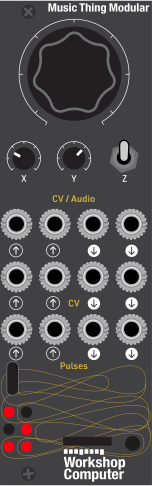
Panel
README
Cellular Automata Sequencer
A generative gate and CV pattern generator for the Music Thing Modular Workshop Computer, inspired by the NLC Cellular Automata Eurorack module.
Source code and latest release: https://github.com/ainews1/ca_sequencer
What It Does
This program card implements a 16-cell 4x4 grid running cellular automata rules 90 and 150. Each cell turns on or off based on its neighbors, creating evolving, unpredictable gate patterns.
Unlike the hardware module, this version adds:
- Quantized melody — CV Out 1 outputs 1V/oct pitch from the CA state
- Selectable scales — chromatic, major, minor, minor pentatonic, dorian
- Rule morphing — blend between Rule 90 and Rule 150 via CV In 2
- Clock division — sync to external clock at variable divisions
- Spontaneous seeding — probability-based corner injection via CV In 1
How to Build
Prerequisites
- Raspberry Pi Pico SDK
- CMake 3.13+
- ARM GCC toolchain
Build Steps
cd ~/Workshop_Computer/releases/19_CA_Sequencer
mkdir build && cd build
cmake ..
make -j4
The resulting CA_Sequencer.uf2 will be in the build/ folder. Copy it to your Workshop Computer by holding the BOOTSEL button while connecting USB.
Panel Layout
Inputs
| Jack | Function |
|---|---|
| Pulse 1 | External clock |
| Pulse 2 | Seed trigger (injects energy into 4 corners) |
| CV 1 | Seed probability / chaos modulation |
| CV 2 | Rule morph (0V = Rule 90, ~5V = Rule 150) |
Outputs
| Jack | Function |
|---|---|
| CV 1 | Quantized 1V/oct melody (root = X, scale = Y) |
| CV 2 | Left/Right grid imbalance |
| Pulse 1 | Master gate (high when any cell is on) |
| Pulse 2 | Accent gate (high when center 4 cells active) |
| Audio 1 | Bitmask of cells 0-7 as voltage levels |
Controls
| Control | Function |
|---|---|
| Main Knob | Free-run rate (Up) or clock division (Mid) |
| X Knob | Root note (C .. B) |
| Y Knob | Scale select: chromatic, major, minor, minor pentatonic, dorian |
| Switch Up | Free run (internal clock) |
| Switch Mid | External clock |
| Switch Down | Reset grid to single seed (momentary) |
LEDs
Shows the top-left 3x2 window of the 4x4 grid:
[0] [1]    <- row 0
[2] [3]    <- row 1
[4] [5]    <- row 2
How the Algorithm Works
The grid uses a Von Neumann neighborhood (4 adjacent neighbors: up, down, left, right).
- Rule 90: new state = parity of neighbors (XOR)
- Rule 150: new state = center XOR parity of neighbors
The Y knob morphs between these two rules probabilistically.
Patching Ideas
- Clock divider: Patch the A-160-2 (or any clock divider) into Pulse In 1
- Extract 8 gates: Use Audio Out 1 with a multi-window comparator or sample & hold to derive individual cell gates
- Feedback seeding: Patch Pulse Out 1 or 2 back into Pulse In 2 for self-modifying behavior
- Quantize CV Out 1: Send density CV to a quantizer for generative melodies
License
MIT