4 BYO Benjolin
Chaotic Benjolin-inspired program combining rungler-style modulation, quantized CV, and pulse generation. Forward/back clocks can be driven from Pulse In 1 and Pulse In 2. The card blends internal randomness with external modulation for probability, offset, and amplitude. The Z switch sets how shift-register cells are written on each clock: - Up (Double Length): toggles the write cell each clock, producing a stable loop of double length. - Middle (Unlock): writes from the data input (or internal noise) when data exceeds the Chaos threshold. - Down (Write): forces the write cell to a fixed value. The Chaos, Offset, and Chaos VCA knobs behave the same in all switch positions.
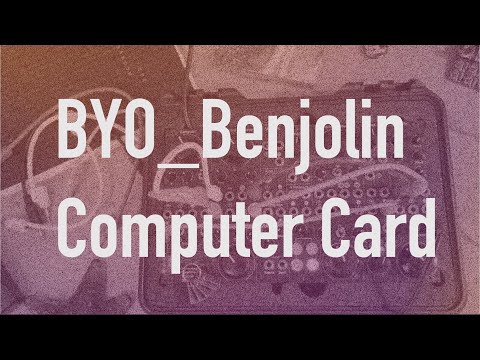
Panel
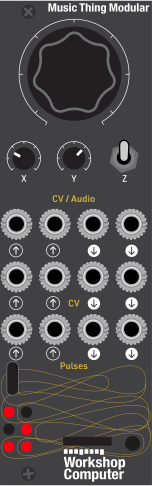 ChaosOffsetChaos VCAData InLock CVOffset CVVCA CVFWD Clk InBack Clk InRaw Out 1Raw Out 2Quant Out 1Quant Out 21-Bit Out 11-Bit Out 2
Controls
Chaos
Lock (stable loop) through Chaos (random) probability that shift-register cells change
Offset
Sets output offset amount (or depth for Offset CV / CV In 1 modulation)
Chaos VCA
Scales rungler output amplitude (or depth for VCA CV / CV In 2 modulation)
Double Length: Toggles the write cell each clock, producing a stable loop of double length
Unlock: Writes from the data input (or internal noise) when data exceeds the Chaos threshold
Write: Forces the write cell to a fixed value
Inputs
Outputs
Data In
External data source for shift-register writes in Unlock (middle) switch mode; normalled to internal noise
Lock CV
Modulates the Chaos/Lock probability alongside the Chaos knob
Offset CV
Modulates the Offset amount used in rungler processing
VCA CV
Modulates the Chaos VCA depth for output scaling
FWD Clk In
Rising edge advances the shift register in the forward direction
Back Clk In
Rising edge advances the shift register in the reverse direction
Raw Out 1
Audio-rate rungler output channel 1
Raw Out 2
Audio-rate rungler output channel 2
Quant Out 1
Quantized MIDI-note CV derived from channel 1 rungler state
Quant Out 2
Quantized MIDI-note CV derived from channel 2 rungler state
1-Bit Out 1
Single-bit pulse output from the shift-register state (channel 1)
1-Bit Out 2
Single-bit pulse output from the shift-register state (channel 2)
README
#BYO_Benjolin Computer Card
Along with the other elements in the Workshop System, this card provides the opportunity to Build Your Own Benjolin or a completely different chaotic instrument of your choice.
Without any external data input, the BYO_B behaves like a 6 (or 12) step turing machine using an internal noise source. The shift register here has 2-bits in each cell (0,1,2, or 3 in each cell instead of just 1/0) which gives this card its own voice.
Plug a Sine or Triangle VCO into the data input and modulate the frequency of that oscillator with RAW OUT 1 or 2. Monitor the VCO (optionally filtering / ring modulating) and you have a strange Benjolin implementation but maybe you can make it even weirder?
Simultaneously clocking the FWD and BACK CLK inputs will result in halted / glitchy fun
Audio rate clock encouraged but not for the faint of heart.
A big thank you to Tom Whitwell, Chris Johnson, and Rob Hordijk